In shortThe Angkor Wat hot air balloon most visitors end up on is a tethered helium balloon flown on a cable. It rises to about 120 m (394 ft) for a ride of 10 to 15 minutes, carries up to 30 passengers and needs no Angkor temple pass. It flies from sunrise to sunset depending on weather, with afternoon slots suggested November to April and morning slots May to October.
120 m (394 ft)Tethered flight altitude
10 to 15 minutesTime in the air
up to 30 passengersBasket capacity
from $49Private ground day tour
What actually flies beside Angkor Wat
The aerial attraction beside Angkor Wat is a tethered helium balloon on a cable. The basket climbs to about 120 m (394 ft), holds that height for 10 to 15 minutes, then winches back down, and it takes up to 30 passengers at a time. No Angkor temple pass is needed for the ride, which sits outside the park's ticketing.
The balloon here is tethered, so read any listing that promises a balloon ride over the temples as this flight unless it states otherwise in writing. There is no drift, no chase vehicle and no landing field: you rise, you look, you descend. Treat the slot as a short viewing platform in the air and plan the day's sightseeing on the ground.
What you can actually see from 120 m
At about 120 m you are roughly twice the height of Angkor Wat's central tower, which stands 65 m above the ground, and that is the point at which the plan of the place finally reads. From the basket the layout comes apart into measurable bands: water about 190 m wide running a perimeter of over 5 km, the 3.6 km outer wall set inside it, and 162.6 hectares (402 acres) of temple ground held within that wall. Standing on the causeway you register water and stone in front of you. From the air it resolves into a rectangle of water with a single 350 m spine of sandstone crossing it to the west gate.
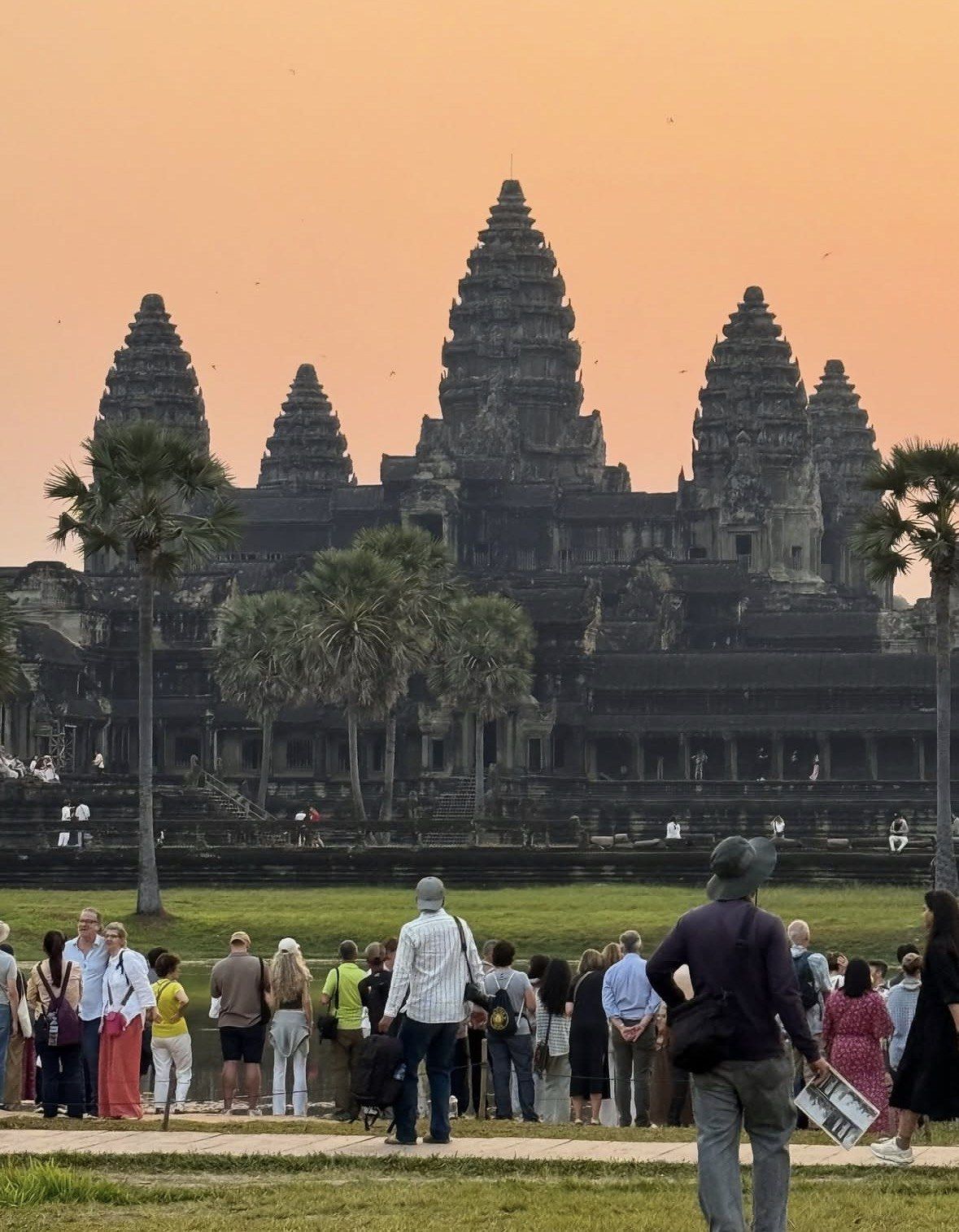
Angkor Wat faces west, unusually for an Angkorian temple, and the orientation is obvious from above: causeway, gate and five towers on one axis pointing back towards Siem Reap, with forest closing in on all four sides of the moat. The reported views from the balloon take in Angkor Wat, Phnom Bakheng and the West Baray, and on clear days Tonle Sap Lake and Phnom Krom to the south.
Detail is what you lose up there. Ten to fifteen minutes at that height gives you scale and layout, and nothing of the Churning of the Sea of Milk on the eastern gallery wall or the procession of Suryavarman II on the southern one. Walk the galleries for those.
The ground day that leaves room for a flight
A compact guided day is what frees the end of the afternoon for an aerial slot: the Angkor Wat Private Day Tour from Siem Reap runs 6-7 hours from $49, with hotel pickup and drop-off, an experienced English-speaking guide and cold bottled water, rated 5.0 ★ (1,052 reviews). Count the Angkor National Park ticket separately when you work out the day, $37 per person, since the listing marks it as required and outside the tour price.
★ 5.0/5 · 1,052 reviews
Dawn flight or late afternoon
A dawn slot competes with the best hour in the park. Angkor Wat admits visitors from 5:00 AM, and the sun itself arrives later: about 05:39 at the June solstice, about 06:08 at the March equinox, about 06:22 in December and no earlier than around 06:31 in mid-January. Sitting in a basket at that moment means you are not on the causeway between the two reflection ponds, which is where you want to be on a first visit.
Late afternoon fits better. The temple's own gates shut at 5:30 PM, an hour before the park closes at 6:30 PM, and that hour is otherwise dead time for anyone left outside Angkor Wat. Sun-down comes at about 18:34 at the June solstice, 18:15 at the March equinox and 17:43 at the December solstice, which keeps the light you want for a flight inside the park's hours whatever month you arrive. Check the slot on the day: the balloon goes up only when the weather allows.
| Slot | Months suggested for it | Sun times to plan against | How it sits in the day |
|---|
| Morning flight | May to October | Sunrise about 05:39 at the June solstice | Clashes with Angkor Wat's 5:00 AM opening, so you give up the dawn causeway for the view |
|---|
| Afternoon flight | November to April | Sunset about 17:43 in December, 18:15 at the March equinox | Slots in after Angkor Wat closes at 5:30 PM and before the park's 6:30 PM closing |
|---|
Weather limits and the months that work
Operation is described as sunrise to sunset depending on weather, and that last clause does the real work. A balloon on a cable is held up by helium and held down by a winch, so wind, rain or a building storm cell keeps it on the ground. Plan the flight as the part of the day that can disappear without wrecking anything else.
Season decides which half of the day is offered: afternoon flights from November to April, morning flights from May to October. That tracks the monsoon. June to October brings storms, road damage, landslides and flash flooding, and the dry months are the easier time to be out at the temples at all. The season page on this site breaks the months down in more detail.
If your dates fall in the wet half of the year, keep the aerial slot loose and the ground days flexible. A 3-day pass at $62 covers three visit days and the official site states it expires in 7 days, so a washed-out afternoon costs you no entries and you can shift the temple morning instead.
Fitting the flight around a temple morning
Build the day on the opening hours and drop the balloon into the gap. Angkor Wat lies about 6 km north of Siem Reap town centre, roughly 12 minutes by road, and admits visitors from 5:00 AM; the stairway to the Bakan upper level opens later, at about 6:40 AM, by the wooden stairs on the eastern side. Entry to the Bayon, the Baphuon and Ta Prohm starts only at 7:30 AM, which means that between 5:00 and 7:30 Angkor Wat is the main temple you can be standing in, and a morning flight eats straight into it.
That leaves the afternoon. Angkor Wat shuts at 5:30 PM, and the ground alternatives for the last hour are Preah Khan, open 7:00 AM to 6:30 PM, and Phnom Bakheng, about 1.5 km from Angkor Wat and listed to 7:00 PM, though you should plan to be down by the park's 6:30 PM closing. An aerial slot replaces one of those rather than adding to a full circuit: the drive out, the queue and 10 to 15 minutes aloft will take the end of the day.
One practical note on the ground side: staff scan your pass at every temple checkpoint, so it stays with you all day, even on an afternoon when you are only partly inside the park.
- 5:00 AM: Angkor Wat causeway and the outer gallery
- About 6:40 AM: the Bakan stairway, with modest dress required
- 7:30 AM onwards: the gates of Angkor Thom and the Bayon inside it, then Ta Prohm a further 3 km north-east of Angkor Wat
- After 5:30 PM: the aerial slot, or Preah Khan to 6:30 PM, or Phnom Bakheng until the park's 6:30 PM closing
When the aerial slot is worth it
Add it once, late in the afternoon, on a day when the temples are already covered and the weather is settled. Ten to fifteen minutes at 120 m is a genuinely different reading of Angkor Wat's 162.6 hectares and it takes only the last hour or so of a day. It will not stand in for a guided morning, so do not plan a trip around it.
Keep the ground tour as the core of the visit. A single pass opens more than 50 accessible temples, and getting to them is a small circuit of about 17 km (10.5 miles) or a grand circuit of about 25 km (15.6 miles) behind a driver, distances a tethered basket does nothing to cover.
Questions people ask
Can I fly a drone over Angkor Wat instead?
Plan on no. Drones need prior permission from the APSARA Authority; without it, assume they are not allowed and count on the tethered balloon for the only aerial view you can rely on.
Is sunrise better from the balloon or from the causeway?
From the causeway, on a first visit. Angkor Wat opens at 5:00 AM and the two ponds flanking the 350 m causeway sit in front of the third set of steps beside the outer libraries, which is where the reflection shots come from. Sunrise falls between about 05:39 in June and around 06:31 in mid-January, so the balloon slot and the dawn causeway slot land in the same hour.
How much time should I set aside for the balloon stop?
The flight is 10 to 15 minutes, but the slot in your day is longer. The launch area sits near Angkor Wat, about 6 km from Siem Reap town centre or roughly 12 minutes by road, and the basket takes up to 30 passengers at a time, so there may be a wait for your turn. Allow the last part of an afternoon instead of squeezing it between two temples.
Does the balloon run all year?
It is described as flying from sunrise to sunset depending on weather, year round, with the suggested slot changing by season: afternoons from November to April, mornings from May to October. June to October is the monsoon, with storms, road damage and flash flooding, so expect more cancelled slots and more time lost to rain in those months.
Do I need an Angkor pass for the flight?
Not for the balloon itself, which is a separate attraction outside Angkor Temples Park rather than a monument inside it. You do need a pass for every temple you enter that day, and it is scanned at each checkpoint. Your tour guide can obtain the pass for you.
Read also