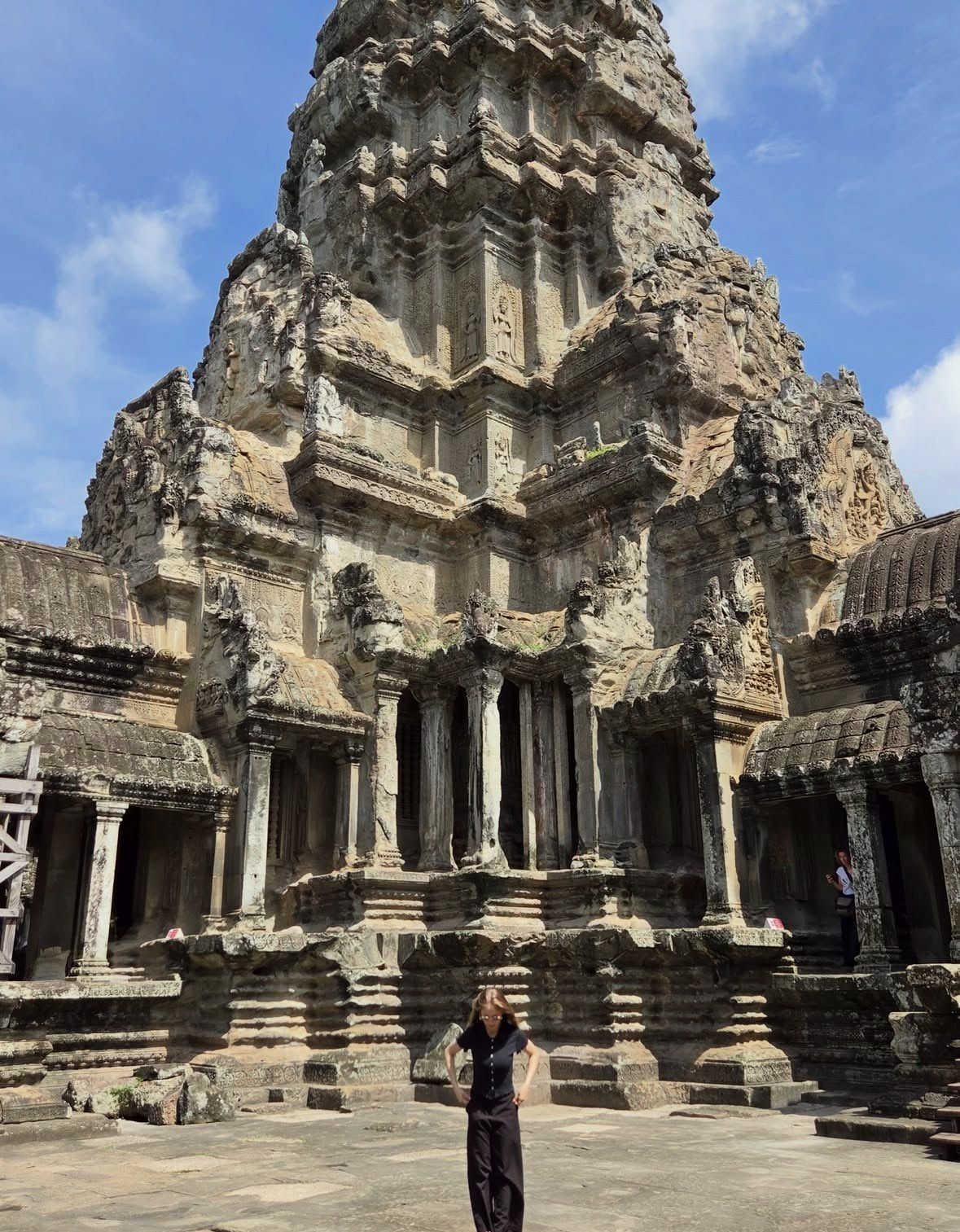
In shortAngkor Wat runs west to east inside: a moat about 190 m wide, a 350 m causeway, the entrance gate, then an outer gallery of 187 m by 215 m carved with bas-reliefs, the Preah Poan cruciform cloister, a second enclosure of 100 m by 115 m, and the Bakan upper level, whose central tower stands 65 m above the ground. You have from 5:00 AM until 5:30 PM to walk that sequence.
190 mmoat width
3.6 kmouter wall length
187 m by 215 mouter gallery
65 mcentral tower above ground
Crossing the moat and the western causeway
Angkor Wat faces west, unusual for an Angkorian temple, so you arrive on the side the builders intended. The moat is about 190 m wide with a perimeter of over 5 km, the wall behind it runs 3.6 km, and the enclosure they define covers 162.6 hectares (402 acres). The ticketing authority calls it the largest religious monument in the world.
The causeway across the water is 350 m long and ends at the western entrance gate. The temple comes into full view only once you are through it: three rectangular galleries rising one above the other towards the central tower. The whole structure went up in the early 12th century for Suryavarman II, who meant it to serve as his state temple and then as his mausoleum, with Vishnu as its first dedication. By the end of that century it was Buddhist, and people still worship here.
Hours decide how much of the interior you actually see. The official site gives the temple itself 5:00 AM to 5:30 PM, an hour short of the 6:30 PM park closing, so the gate you walked in by shuts before the park does. The galleries are quietest in the first hour and again from about four o'clock. Plan the walk so nothing important is left for the final twenty minutes.
A guided day around the four relief walls
Nothing on the wall tells you what the panels show, so an 8-hour day from $18 with an English tour guide, an air-conditioned vehicle, cold water and a cold towel is the simplest way to read the galleries rather than walk past them.
★ 5.0/5 · 13,742 reviews
The outer gallery and the Angkor Wat bas reliefs
The outer gallery is a rectangle of 187 m by 215 m, and its inner wall is carved almost from end to end. Most visitors cut this part short, because they push straight for the towers and come back to the reliefs with nothing left in their legs. Walk it first.
Begin at the north-west corner and go anticlockwise, the direction the panels were laid out to be read. Two battles fill the western wall: the Battle of Lanka out of the Ramayana, then the Kurukshetra War out of the Mahabharata. Turn the corner south and you reach the only historical scene in the temple, the procession of Suryavarman II, set beside the panel of the 32 hells and 37 heavens.
The eastern wall carries the Churning of the Sea of Milk, with 92 asuras and 88 devas hauling on the serpent Vasuki under Vishnu's direction; if you look at one panel properly, make it this one. The northern wall shows Krishna's victory over the asura Bana. Keep your hands off the stone the whole way round, since touching carvings is prohibited under the visitor code of conduct.
| Gallery wall | Main subject | What to notice |
|---|
| West | Battle of Lanka (Ramayana) and the Kurukshetra War (Mahabharata) | Start at the north-west corner and read anticlockwise |
|---|
| South | Procession of Suryavarman II, then the 32 hells and 37 heavens | The only historical scene in the temple |
|---|
| East | The Churning of the Sea of Milk | 92 asuras and 88 devas hauling the serpent Vasuki under Vishnu's direction |
|---|
| North | Krishna's victory over the asura Bana | Closes the circuit back at the north-west corner |
|---|
Preah Poan, the libraries and the second enclosure
Past the carved wall you step into Preah Poan, the cruciform cloister, where covered walkways divide four courtyards. The basins sunk into them are dry, so there is no reflection to hunt for here. Walk it slowly anyway instead of cutting straight through to the stairs; the cloister is still used for prayer.
The libraries stand apart from the galleries as freestanding buildings. The pair out on the causeway, beside the third flight of steps, is the easiest to walk right around, and it puts the scale of the blockwork at eye level before you go into the enclosures.
Beyond the cloister the second enclosure measures 100 m by 115 m. It is tighter and darker than the outer gallery, the sightlines shorten, and from its courtyards you get your first proper look up at the stairs to the top.
The Angkor Wat upper level and the climb to the Bakan
The upper level is the Bakan, a square of about 60 m carrying the central tower, which rises 43 m above its own base and 65 m above the ground. The access rules here are different from the rest of the monument.
The staircase opens later than the temple, at about 6:40 AM, and the way up is the wooden stairway on the eastern side, so you cross the inner enclosure to reach it rather than climbing at the first steps you see. Groups of 100 have been let up at a time with 15 to 30 minutes each, and you need to be dressed modestly before anyone waves you onto the stairway. These rules can change, so check what is in force on the day.
Four days in every month, the Buddhist holy days, the Bakan belongs to Cambodian visitors who come up to worship. Plan the climb for roughly an hour after sunrise, once the stairway has opened, and accept that it may not happen on your morning.
- Opens about 6:40 AM, later than the temple's 5:00 AM admission
- Wooden stairway on the eastern side of the inner enclosure
- Reported limit of 100 people at a time, 15 to 30 minutes each
- Shoulders and knees covered, checked before you go up
- Reserved for Cambodian worshippers on four Buddhist holy days a month
How long to allow, and which tour gives you that time
Inside, Angkor Wat is a long walk taken slowly: 350 m of causeway, a lap of a gallery 187 m by 215 m, the cloister, the second enclosure at 100 m by 115 m, then the stairs. With a real stop at each of the four relief walls it fills a morning on its own, and the Bakan adds its 15 to 30 minutes on top of whatever wait has built at the foot of the stairway.
Choose by how much of that time you control. Eight hours from $18 buys the Angkor Wat Sunrise or Sunset Tour with Guide from Siem Reap, 5.0 ★ (13,742 reviews): an English tour guide goes round the galleries with you, there is an air-conditioned vehicle between sites with cold water and a cold towel, and you decide whether the temple is seen at dawn or late in the afternoon, with the park pass paid on top. A guide earns the money on the reliefs, where nothing on the wall tells you which king rides in the procession or which army is facing which.
Cut the day down and keep the pace yours with the Angkor Wat Private Day Tour from Siem Reap, 6-7 hours from $49, rated 5.0 ★ (1,052 reviews): the driver collects you at your hotel and brings you back, an experienced English-speaking guide stays with you through the galleries, cold bottled water comes with it, and transport is a tuk-tuk for 1-3 passengers or a minivan once you are 4 or more. That listing puts the Angkor National Park ticket at $37 per person, required of you and charged outside the tour price.
Serious cameras change the arithmetic. The Angkor Wat Photography Tour runs 8-10 hours from $105, 5.0 ★ (2 reviews), with private superior air-conditioned transport and an English-speaking guide, and it is the only tour on this site whose price already covers the 1-day temple entrance fee of $37 per person. The guide waits with a company sign beside the map at the entrance of the hall where the park tickets are issued.
Dress and conduct inside the galleries
Cover shoulders and knees before you leave your room. The visitor code of conduct bans revealing clothing in sacred places, foreign-office advice is that too little clothing can get you refused entry at religious sites including Angkor Wat, and the same standard is applied at the foot of the stairway to the upper level.
The rest of the code is short and applies right through the interior. Angkor has been smoke-free since 2012. The code would rather you left backpacks, sharp-tipped umbrellas, tripods and high heels outside the galleries. Touching carvings, sitting or leaning on structures, moving or taking artefacts and graffiti are all prohibited. Ask permission before photographing monks, and women should not touch them or stand and sit too close. Respect the signage where an area is closed off, and leave the loose stones alone rather than climbing on them.
Staff scan and verify your pass at the checkpoint, so keep it on you from the causeway to the top level and out through the gate again.
Questions people ask
Is there a separate ticket for the inside of Angkor Wat?
No, the interior is not ticketed separately. The Angkor Temples Park pass is scanned and verified at the checkpoint and covers the galleries, the cloister and the upper level. If you are booked on a guided day, the guide can obtain that pass for you.
Can I use a tripod in the galleries?
The visitor code of conduct discourages tripods inside the temples, along with backpacks, sharp-tipped umbrellas and high heels. Touching carvings and leaning on structures are prohibited, so bracing a camera against a relief is out as well. Work handheld and take the first hour after the 5:00 AM opening, when the light along the outer gallery is lowest and the walkways are still empty.
What happens inside the temple on Buddhist holy days?
The Bakan is given over to Cambodian visitors for worship on the four Buddhist holy days each month, which rules the climb to the top level out for everyone else. The rest of the monument keeps its normal hours of 5:00 AM to 5:30 PM. The arrangement can change, so ask your guide what applies on your date.
Is late afternoon a good time to walk the interior?
Yes, and it is the overlooked half of the day. Angkor Wat closes at 5:30 PM while the park stays open to 6:30 PM, so a start around four o'clock gives you the reliefs and the cloister with far less traffic than dawn brings.
Read also