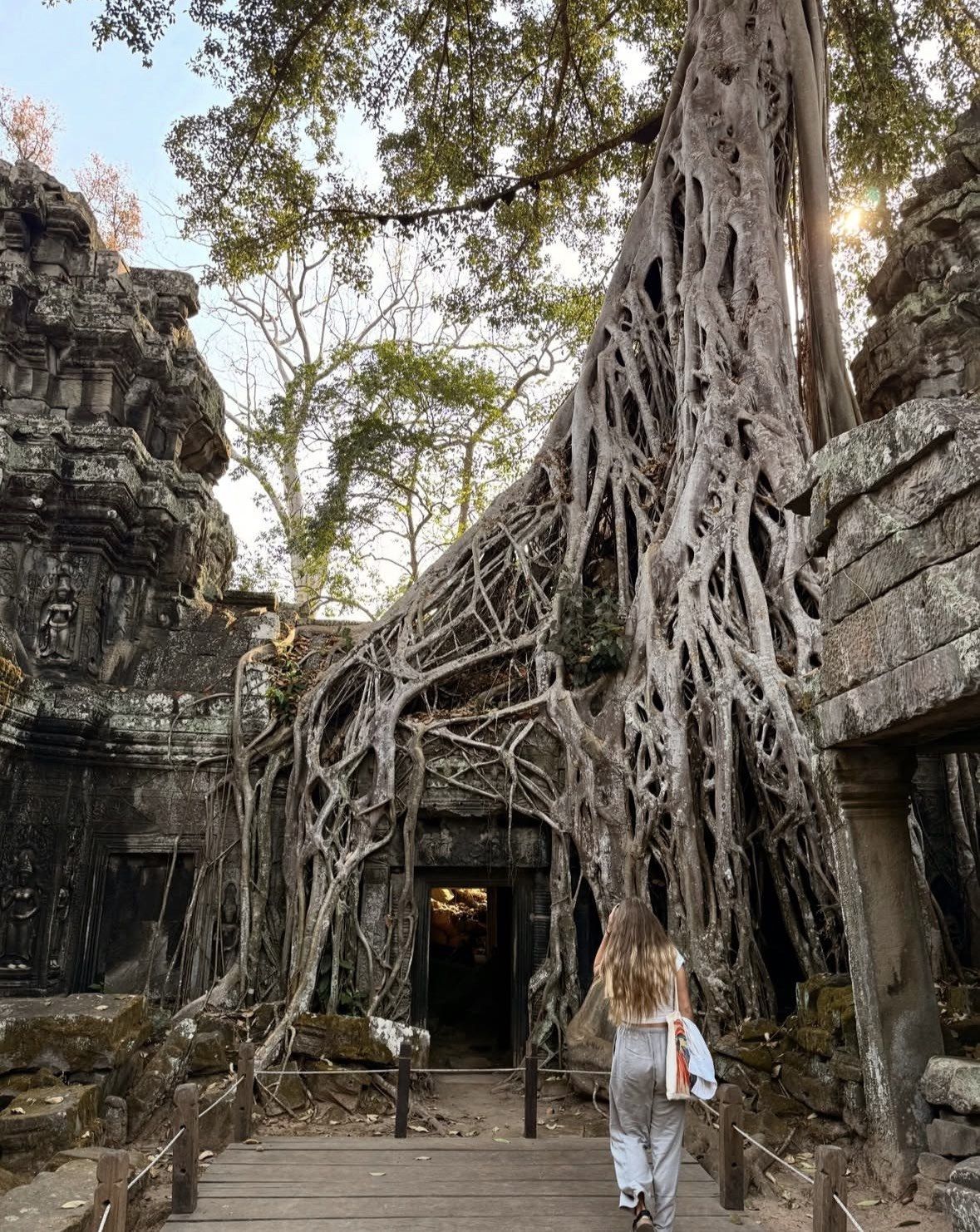
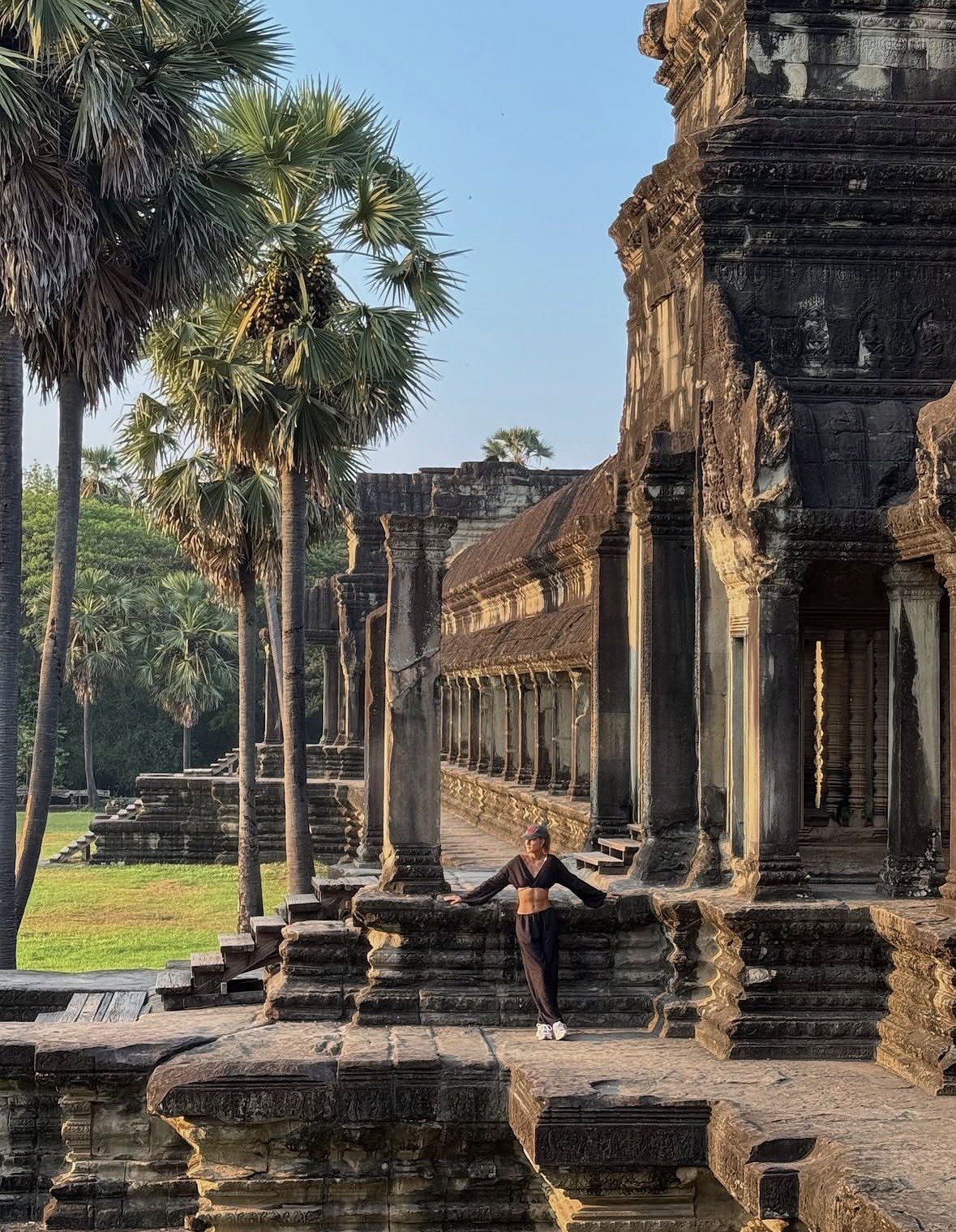
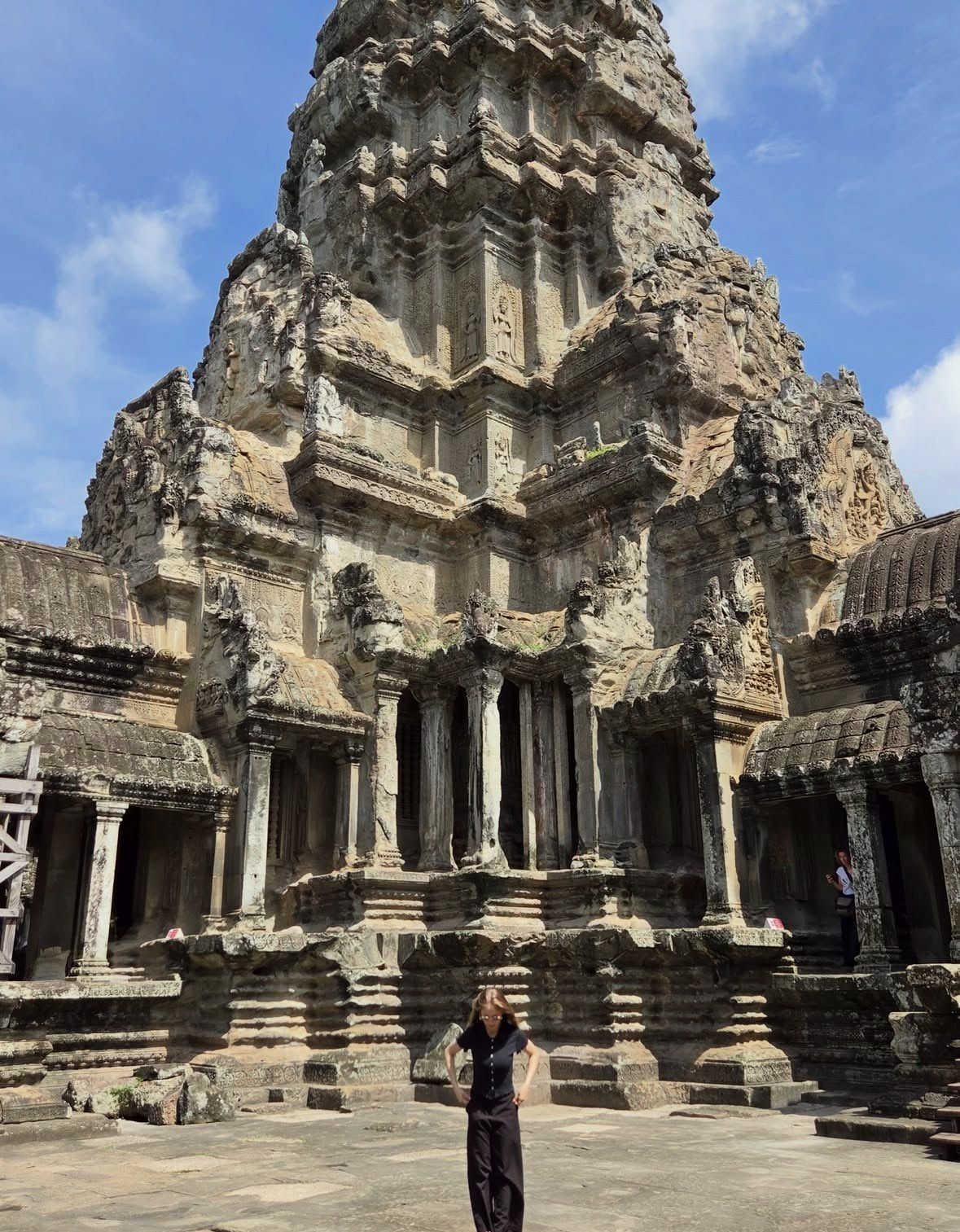
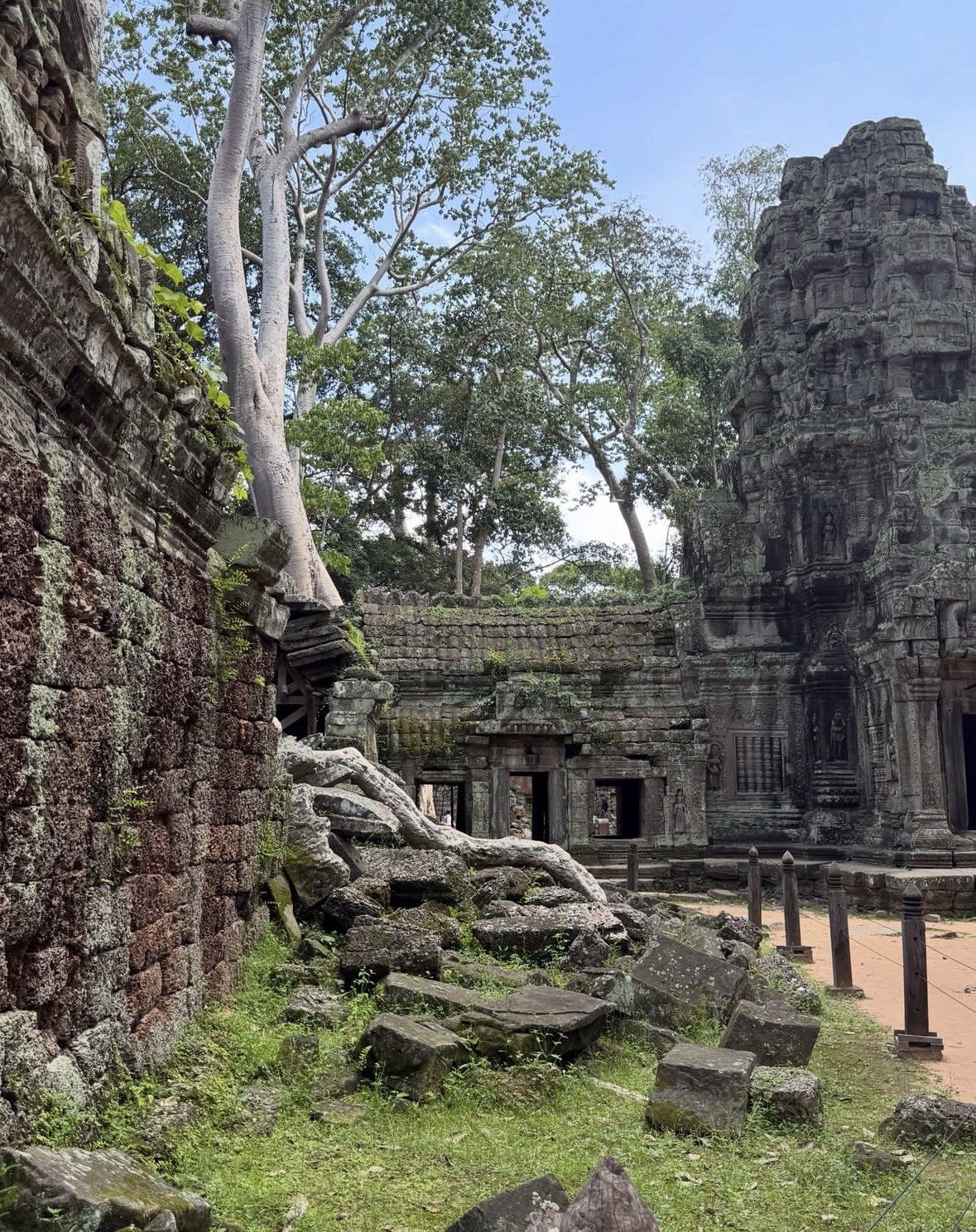
In shortTa Prohm, the temple used in the 2001 film Lara Croft: Tomb Raider, lies about 3 km north-east of Angkor Wat and some 12 km from Siem Reap. It opens 7:30 AM to 5:30 PM, two and a half hours after Angkor Wat starts admitting visitors at 5:00 AM, and entry is covered by the Angkor pass.
1186 ADdate on the foundation stele
7:30 AM-5:30 PMTa Prohm opening hours
3 kmnorth-east of Angkor Wat
17 km (10.5 miles)the small circuit loop
What you see at the Ta Prohm Tomb Raider temple
The foundation stele gives the date 1186 AD. Jayavarman VII built it as Rajavihara, a Mahayana Buddhist monastery, and dedicated it to his mother. The same programme produced the Bayon, his state temple, and Preah Khan, dedicated in 1191 to his father.
The nickname comes from the 2001 film Lara Croft: Tomb Raider, shot partly here inside the park. One film credit is why a handful of doorways and root-covered walls have a line of people in front of them by mid-morning, while courtyards fifty paces away stay empty. Walk past the busy doorway and come back to it later.
Nothing here has been left exactly as it was found. Conservation is run jointly by the Archaeological Survey of India and APSARA, and by 2013 the ASI had restored most of the complex. Wooden walkways, platforms and roped railings keep visitors off the stone, so the route through the enclosures is largely laid out for you, and sections under conservation work are closed off while that work goes on.
The Ta Prohm trees and the platforms built around them
Two species do most of the work: silk-cotton (Ceiba pentandra) and thitpok (Tetrameles nudiflora), the large trunks standing in the galleries. Strangler fig and gold apple fill the joints.
Wooden bridges carry you over the first moat, and platforms serve the Hall of Dancers and the tree-root photo spots. The monks' cells are closed; you can only look at them from the moat-crossing platforms, so do not go hunting for a way in. Which root spots are open changes with conservation work, so take the route the railings and signage give you on the day, and keep off loose stones.
If the root spots are the reason you came with a camera, the Angkor Wat Photography Tour builds a longer day around light and shooting time: 8-10 hours, from $105, 5.0 ★ (2 reviews), private superior air-conditioned transport, an English-speaking guide, and the $37 per person one-day temple entrance fee sitting inside the price rather than on top of it.
- Silk-cotton, Ceiba pentandra: the pale, heavy trunks over the galleries
- Thitpok, Tetrameles nudiflora: the other large tree in the enclosures
- Strangler fig, Ficus gibbosa: smaller, in the joints of the stone
- Gold apple, Diospyros decandra: smaller again, scattered through the complex
Best time of day for the stop
Ta Prohm takes its first visitors at 7:30 AM, and that opening slot is the one to claim. Ta Prohm is a narrow walkway circuit with fixed platforms at the famous spots, so twenty minutes early is worth more here than at a wide monument. Everyone who stood on the Angkor Wat causeway at 5:00 AM has two and a half hours to fill before Ta Prohm opens, and most of them spend it on breakfast and the Angkor Thom gates. The crowd therefore builds through the middle of the morning, which leaves the first half hour after opening the quietest part of the day.
Late afternoon works too. Ta Prohm closes at 5:30 PM, the same hour as Angkor Wat. Being moved off these platforms at closing does not end your afternoon, since Preah Khan (7:00 AM to 6:30 PM) is still admitting people, and Phnom Bakheng is listed to 7:00 PM, but plan to be down by the park's 6:30 PM closing.
Time needed is modest. No long causeway, no climb, and much of the walking is on installed platforms, so the stop fits as the second or third temple of a morning. The queue at the root spots is the one thing that slows you down.
- Dawn shape for a quiet Ta Prohm: Angkor Wat from 5:00 AM, Ta Prohm at the 7:30 AM opening, Angkor Thom and the Bayon afterwards (the reverse of the usual order)
- Afternoon shape: Ta Prohm in the last hours to 5:30 PM, then Preah Khan to 6:30 PM or Phnom Bakheng until the park's 6:30 PM closing
- What does not work: arriving at 6:00 AM expecting to get in, or leaving Ta Prohm for the end of a day you started at 5:00 AM
A private day timed to the 7:30 AM opening
Six to seven hours from $49, 5.0 ★ (1,052 reviews). Pickup and drop-off happen at your hotel, with an experienced English-speaking guide, cold bottled water, and transport by tuk-tuk for parties of 1-3 or a minivan once the group reaches 4. Setting your own start time is what gets you to Ta Prohm as the gate opens instead of two hours later. The listing marks the Angkor National Park ticket at $37 per person as required and payable separately.
★ 5.0/5 · 1,052 reviews
Where it sits on the loop
The run out is short: roughly 3 km of road separate Ta Prohm from Angkor Wat, and about 12 km separate it from the centre of Siem Reap. The small circuit, 17 km (10.5 miles) in total, picks it up after the water: Angkor Wat first, out to Srah Srang, then west to Ta Prohm and Ta Keo, with the Victory Gate on the eastern side as the way into the walled city of Angkor Thom.
That sequence puts Ta Prohm before the Bayon, the reverse of the usual dawn order, and it is worth it if you want Ta Prohm quiet. Both open at 7:30 AM and close at 5:30 PM, but the Bayon sits inside a walled city you can wander for an hour without queueing, while Ta Prohm funnels everyone onto the same platforms. Take the bottleneck first.
Pick the grand circuit and Ta Prohm drops out of the day: that 25 km (15.6 miles) loop pushes on east from Srah Srang to Pre Rup, East Mebon, Neak Pean and Preah Khan, coming back into Angkor Thom through the north gate. That is the argument for a longer pass. With the 3-day pass at $62, which the official site states expires in 7 days, the two loops get a morning each, and Ta Prohm gets the 7:30 AM opening on the day with the least ground to cover.
Hours, pass and the rules that apply inside
Entry is covered by the Angkor pass, which staff scan at every temple checkpoint, so it stays with you all day. Your tour guide can obtain it for you, the least fuss if someone is already driving you out.
Settle what you are wearing at the hotel, because it has to carry you through every checkpoint of the day. The visitor code of conduct bans revealing clothing in sacred places, and foreign-office advice is blunt that it can cost you admission to religious sites, Angkor Wat among them, which on a small-circuit morning means being turned back after the drive out. The same code prohibits touching carvings, leaning or sitting on structures, and climbing on loose stones. Ask before photographing monks.
Footing matters at Ta Prohm. The wooden walkways and platforms are fine underfoot and slippery after rain, and the monsoon runs June to October with storms that damage roads and bring flash flooding. Keep to the main routes and the marked paths around the rural temple areas, and do not let a driving leg between sites run into the dark.
Confirm Ta Prohm's hours at the checkpoint on the day.
| Monument | Hours | Note |
|---|
| Ta Prohm | 7:30 AM to 5:30 PM | Covered by the Angkor pass; confirm the hours on the day |
|---|
| Angkor Wat | 5:00 AM to 5:30 PM | Opens at 5:00 AM for sunrise |
|---|
| The Bayon | 7:30 AM to 5:30 PM | At the centre of Angkor Thom, same opening as Ta Prohm |
|---|
| The Baphuon | 7:30 AM to 5:30 PM | Reopened in April 2011 after a 51-year restoration |
|---|
| Preah Khan | 7:00 AM to 6:30 PM | Open after Ta Prohm and Angkor Wat have closed |
|---|
| Phnom Bakheng | 5:00 AM to 7:00 PM | Latest closing of the main monuments |
|---|
| Angkor Temples Park | 5:00 AM to 6:30 PM | Printed against every pass type |
|---|
Questions people ask
Can I see Ta Prohm at sunrise?
No. The gate here stays shut until 7:30 AM, two and a half hours behind Angkor Wat, the one monument that admits visitors at 5:00 AM. For quieter first light inside the park, Srah Srang opens at that same 5:00 AM hour and Pre Rup from 6:00 AM. The sun comes up at about 05:39 around the June solstice and as late as about 06:31 in mid-January, so the gap you have to fill before 7:30 AM changes with the season.
Is Ta Prohm included in the Angkor pass?
The Angkor pass covers it, and that same pass is scanned at every temple checkpoint you walk through. Having your tour guide obtain it saves you a stop on a morning that has to be at Ta Prohm by 7:30 AM.
Can I combine Ta Prohm and Banteay Srei in one day?
It is a stretch. Banteay Srei stands some 25 km north-east of the main Angkor group, 25 to 30 km out of Siem Reap, which makes it a half-day on its own, and it opens at 7:30 AM, the same hour as Ta Prohm. Pairing the two means hitting both at their busiest with a long drive in between. Give Banteay Srei its own outing, with a car rather than a tuk-tuk for the distance.
Is Ta Prohm worth it in the rainy season?
Yes, but plan around the weather. June to October is the monsoon, when storms damage roads, trigger landslides and bring flash flooding, and the wooden walkways and platforms here turn slippery. If you hold the 3-day pass at $62, which the official site states expires in 7 days, a washed-out temple morning can move to another day inside the week without losing an entry.
How does Ta Prohm compare with Preah Khan for the same kind of atmosphere?
Preah Khan was built for Jayavarman VII to honour his father, with its main image dedicated in 1191, and it has been left largely unrestored, where most of Ta Prohm has been through conservation work by the Archaeological Survey of India and APSARA. The clock is the practical difference: Preah Khan runs 7:00 AM to 6:30 PM, so it works as the late stop after Ta Prohm and Angkor Wat shut at 5:30 PM.
Read also